SAMANTA

SA.MA.NT.A – ScAling-up di un sisteMA aNTi-particolato, anti-coronavirus, biocida Autorigenerante

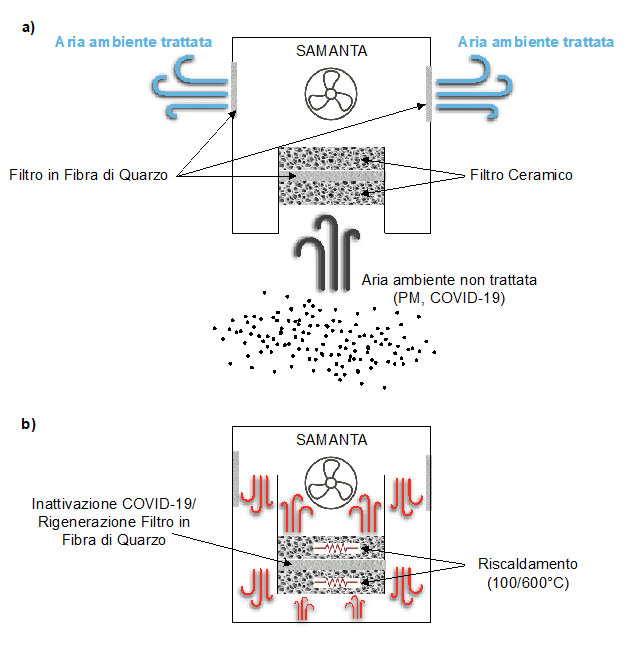
The SA.MA.NT.A project is a scaling-up innovation of a filtration system capable of retaining the totality of particulate matter with diameter greater than 4nm (inorganic, organic, and biological PM) and providing >99.99% filtration efficiency, suitable for any indoor environment.

The system allows the inactivation of COVID-19 and a general biocidal action against all biological elements. It is indeed based on a heat treatment for the inactivation of COVID-19 virus and for the combustion of all particulate material collected on the filter, resulting in a completely biocidal as well as self-healing action of the filter itself, eliminating the production of special waste.

The system is designed to be independent from all possible variants of COVID-19 and any possible future pandemic biota, being the system based on a universal method of inactivation and destruction of any biological structure based on carbon chemistry (thermal method with the possibility of acting up to 900°C).

Project Coordinator: Luca Ferrero
AMYGING

AMYGING

AMYGING – Holistically sustainable multi-modal β-amyloid imaging

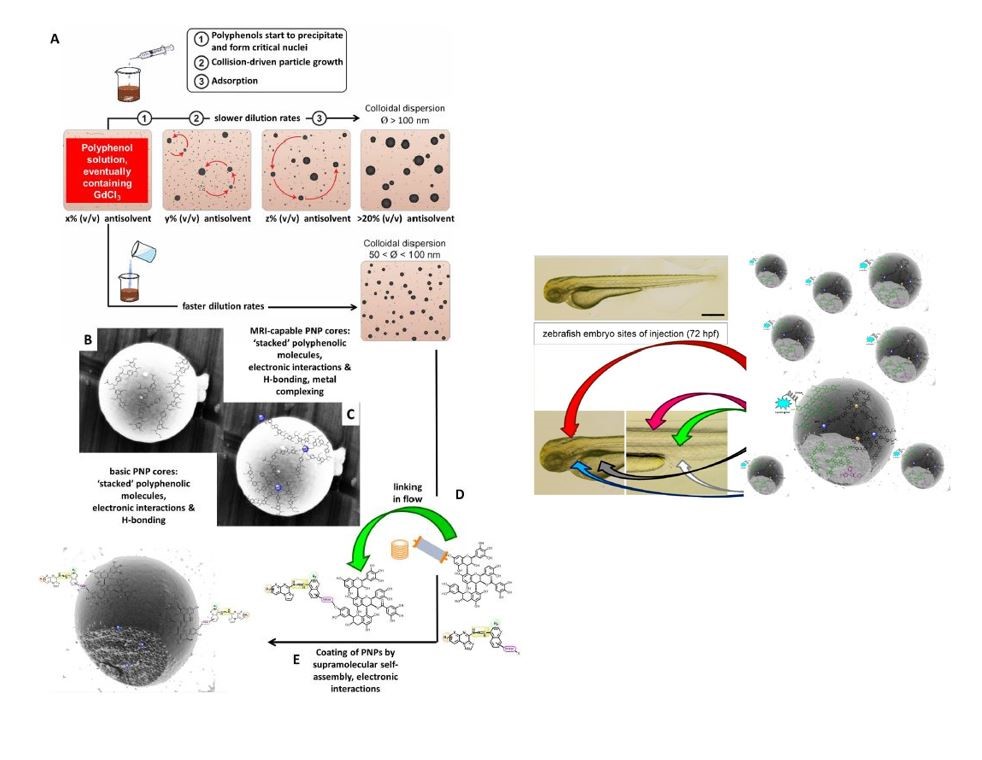
AMYGING will demonstrate in a zebrafish embryo model that natural polyphenol-based carrier systems hold great potential as natural actives useful to form the basis of a highly modular amyloid imaging toolbox suitable for in vivo MRI and difference-fluorescence imaging.

Out-of-the-box approaches for combining traditional amyloid-sensing structures with insights from nanotechnology, molecular electronics and inherent characteristics of natural polyphenols allow for the simultaneous realization of multimodal imaging probes.

AMYGING aims at the implementation of a screening platform for highly sensitive detection of misfolded Aβ-oligomers in the cerebrospinal fluid of Alzheimer’s Disease patients via tunable nanoparticles (NPs). These NPs comprise a core of natural condensed polyphenolic (PNPs) structure complexing gadolinium ions and an outer layer of PNPs that are functionalized with amyloid-sensing small actives (ASSAs), a combination which leads to effectively increased contrast agent concentration in the immediate proximity of Aβ-oligomers for optimum bimodal imaging.

Call: PRIN2022

Grant Agreement: 202295845T

Project Coordinator: Margherita Brindisi (UNINA)

UNIMIB WP leader: Heiko Lange (WP2 Leader), Anita Colombo (WP3 Leader)

AMROCE – AGAINST CECs (AMR BACTERIA AND ANTIBIOTICS) IN WATER BODIES

AMROCE – AGAINST CECs (AMR BACTERIA AND ANTIBIOTICS) IN WATER BODIES

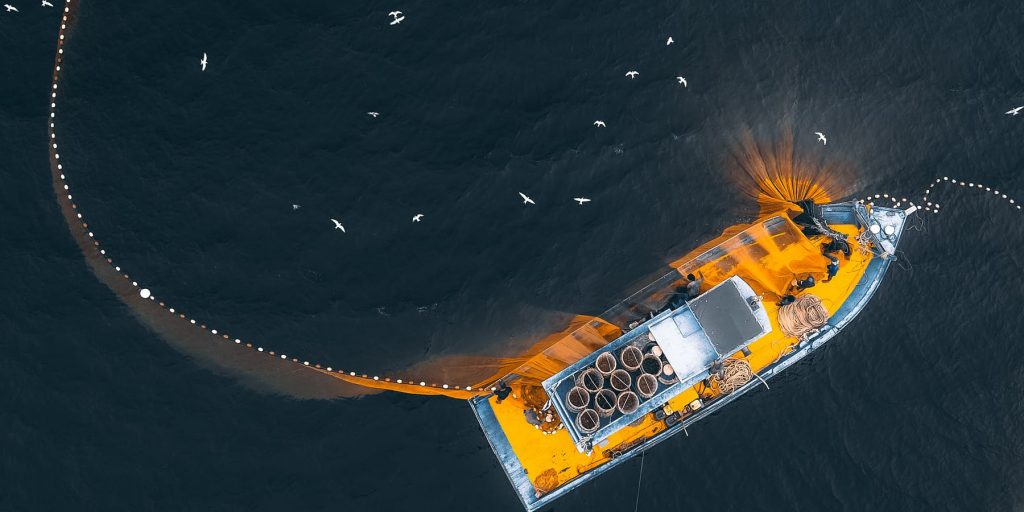
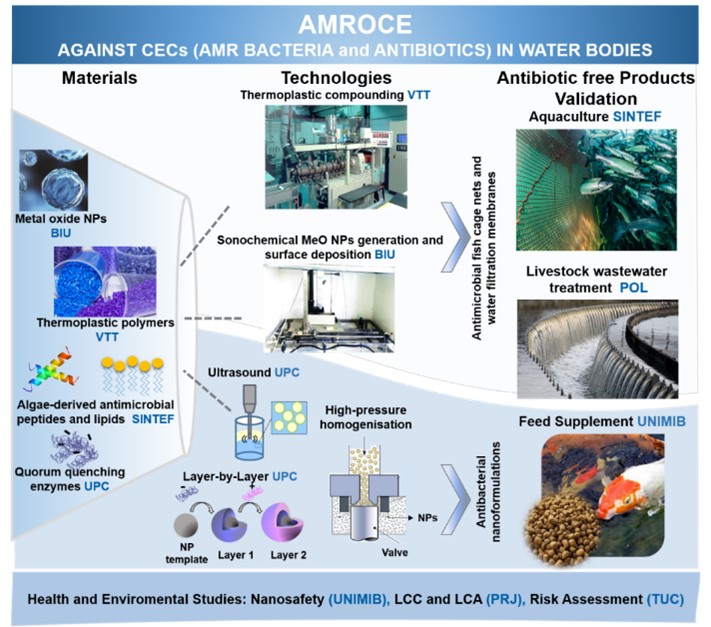
Antibiotics, pathogens and antimicrobial resistant (AMR) bacteria are contaminants of emerging concern (CECs) in water bodies associated to intensive fish and inland animal farming.  AMROCE aims at reducing antibiotic pollution and spread of AMR bacteria in the entire water cycle through a platform of novel antibiotic-free antimicrobial products. In the project, antimicrobial/antibiofilm fish cage nets and wastewater filtration membranes will be developed through polymer and surface nano-engineering. Marine-derived antimicrobial agents and antibiofilm enzymes will be nano-formulated as alternative to antibiotics for fish and animal feed supplement. Human and environmental nanosafety during the manufacturing and use of the novel nanotechnology-embedded products will be continuously evaluated to anticipate nanosafety issues.

UNIMIB is leader of WP3, which aims at identifying the parameters related to the safety of the nano-formulation process for both workers and users, considering not only the existing regulation, but also the gaps existing in the legislation and norms.

Project Coordinator: Tzanko Tzanov (UPC)

UNIMIB WP/Task leader: Paride Mantecca (WP3)

Please visit the webiste of the project amroce.eu

IT-BEST

IT-BEST

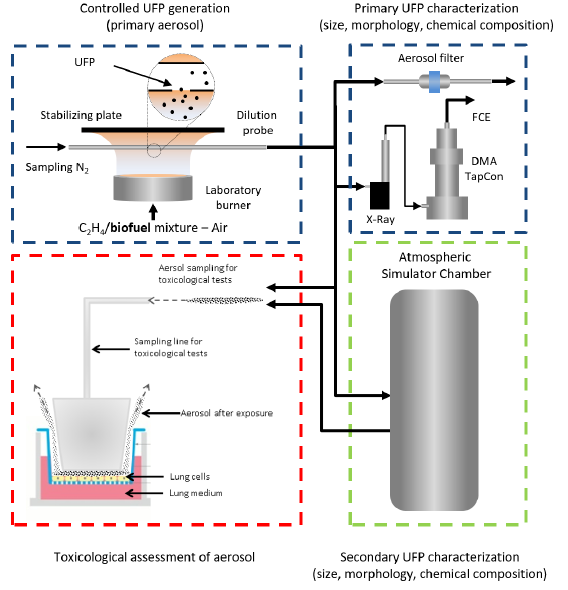
IT-BEST project aims to characterise the formation, the atmospheric ageing and the toxicological effects of ultrafine particles (UFP) resulting from the combustion of biofuels. Indeed, combustion processes involving biofuels may emit UFP that are actually different in size, chemical composition and health effects than those from conventional fossil fuels.

The special interest in UFP is related to evidence, currently available in the literature, that biofuels reduce the total particulate matter emitted, but simultaneously produce smaller particle size with a relevant number concentration, which are potentially more toxic.

Experimental measurements using an atmospheric simulation chamber, will be performed to determine the effect of different biofuels composition, on UFP numbers, size, chemical composition and their transformation under relevant atmospheric conditions as well as their toxicological assessment.

The expected outcome of the research project will result in a better the understanding of different nature and health-related toxicological effects of the carbonaceous particle formed during the combustion of biofuels.

Call: PRIN2022

Grant Agreement: 2022CH87SA

Project Coordinator: Dario Massabò (UNIGE) and Gianluigi De Falco (UNINA Federico II)

UNIMIB WP leader: Maurizio Gualtieri

BIOMAT

BIOMAT

BIOMAT – Open  Innovation Test Bed for Nano-Enabled Bio-Based PUR Foams and composites

The POLARIS Research Center is involved in the European BIOMAT project, funded by the European Commission in the Horizon 2020 framework (Grant Agreement nr.) with the aim of establishing an Open Innovation Test Bed (BIOMAT-TB) with a Single-Entry Point (SEP) . The aim of this project is to accelerate a sustainable European bioeconomy through the development of nanomaterial-based and advanced polyurethane foams (PUR Foams) for various companies (building, construction, automotive, furniture, textiles).

Project ID:953270; Call ID: H2020-EU.2.1.3. – INDUSTRIAL LEADERSHIP – Leadership in enabling and industrial technologies – Advanced materials;   H2020-EU.2.1.2. – INDUSTRIAL LEADERSHIP – Leadership in enabling and industrial technologies – Nanotechnologies

Project coordinator: Dr. Mariana Ornelas (CENTI)

Dissemination Manager: Dr. Pnina Dan (OSM-DAN LTD).

Partner UNIMIB – POLARIS Prof. Paride Mantecca is leader of WP7 – Recycling technologies, nanosafety and regulatory issues with specific focus on Nanosafety and toxicology (Task 7.2).

Further information can be found at the link.

Discover more on the project here!


ASINA – Anticipating Safety Issues at the Design Stage of NAno Product Development

ASINA – Anticipating Safety Issues at the Design Stage of NAno Product Development

Il progetto Horizon 2020 ASINA (Anticipating safety issues at the design stage of nano product development) si propone di implementare strategie di “safe-by-design” per lo sviluppo di nanomateriali intrinsecamente sicuri, che siano a basso rischio, per la salute dell’uomo e dell’ambiente. ASINA è coordinato dal Cnr-ISTEC che vede la partecipazione di 21 membri, tra i quali centri di ricerca, università, SMEs, e oranizzazioni non governative (NGOs) europee e non, afferenti a 8 diversi Paesi europei. Il titolo della call alla quale abbiamo risposto è: “Safe for design: from science to regulation”.

Project Coordinator Prof.  Anna Luisa Costa

Dissemination Manager Dr. Isella Vicini

Partner UNIMIB – POLARIS (Paride Mantecca) is leader of WP2 -MATERIAL SAFETY DESIGN CRITERIA, i cui obbiettivi sono:

  • determinare i design criteria per l’esposizione a NMs, tramite l’identificazione di parametri p-chem (chimico-fisici) che modulano le risposte biologiche in termini di scenari di esposizione
  • determinare i design criteria per l’esposizione a NMs, tramite l’identificazione di parametri p-chem (chimico-fisici) che modulano risposte biologiche in seguito ad un evento molecolare iniziale e/o specifici step presenti all’interno di adverse outcome pathways (AOPs) già caratterizzati
  • utilizzo e adattamento di frameworks per calcolo del rischio (risk assessment) nel contesto di ASINA, fornendo indicazioni pratiche per il read-across di materiali

Per informazioni:

ASINA Web site

CNR Web site

Twitter 

POLARIS